John Kirwan & Salvatore Cimmino
What you are about to read will project you inside a fairy tale, or rather, do you remember the television series “The Twilight Zone”? Where the protagonists were thrown against their will, as in a dream?
Upon my arrival in New Zealand, at Wellington Airport, I found a woman waiting for me, who eventually turned out to be an angel.
From that moment onwards, like an angel, she took care of me as a mother cares for her child, as a woman takes care of her man and just like an angel she supported me with joy in every moment.
This angel’s name is Miriam. Miriam Vender is a Focolarine, a member of the Focolari Movement, founded in 1943 during World War II, out of the Faith of Chiara Lubich. After she met a woman who had just lost four children after a violent bombing that struck the city of Trento, she felt she had to share the pain of the entire humanity.
Today the followers of Chiara Lubich are present in all countries on earth, where they preach the values of solidarity and hospitality, love and brotherhood, tolerance and equality.
Miriam catapulted me into a fairy world, where people have adopted me and given me confidence, have made me feel at ease, so I could focus on my challenge, and from that moment onwards it was a crescendo of emotions through loads of affection, solidarity and sharing, availability and proximity, one meeting after the other: the first person whom I met was Antonio Cacace (Knight of Labour and owner of “Beautiful Italy” – where Miriam works – a Bar/Restaurant/Shop, which became our headquarters), and his family: Luisa, his wife, and three adorable children: Luigi, Anna, and Liberato, who have shown me immense affection: they have opened their house and their hearts as you would with a brother, and they have supported and believed in my project.
Another extraordinary encounter was the one with Toni Mollo, a fisherman like my grandfather, with whom I share a common past, materially poor but rich in joy and serenity. He gave me the All Blacks uniform signed by all the players and their coach, and I accepted it with much joy.
I have received full support and interest by everyone, including people belonging to the health and rehabilitation sectors: like the director of the New Zealand Artificial Limb Board of Wellington, Ray Binet, who was enthusiastic and willing to support and contribute to the success of my project right away from the next stage in Africa, and with whom I shared the necessity and urgency of improving the quality of life of people with disabilities.
The same from academic, economist and writer Harry Mills, with whom I shared a conversation about the fundamental importance of the integration of disabled people in society, which helps to enrich it and improve it in both human and economic terms.
And by the authorities, first and foremost by the Mayor of the city of Wellington, Mrs. Wade-Brown, from whom I have received both support and approval, together with the entire city, and even the whole country: my “Swimming the Seas of the Globe, for a world without fences and without borders” project not only had a national media coverage: upon my return, when I took the flight to Auckland, I was welcomed by the flight attendants almost like a star, after my successful crossing of the Cook Strait had been reported on the first page of the “Dominion Post”, the leading newspaper in Wellington, as well as on national television. I cannot hide the fact that so much attention on myself, while being a great pleasure, has also greatly embarrassed me!
With the Mayor we have agreed on the fact that a city, a nation, a society that does not invest equally on its entire population will be anything but tolerant and welcoming, accessible and fair.
Remember that at the beginning of my story I mentioned a story, a dream, like in the television series “The Twilight Zone”?
At one point we were so depressed by the sea and weather conditions: they were so awful that I had already sent an email to the “New Zealand” travel agency in Rome, to postpone the return flight by at least a week. Yet on the evening of October 9th there came a phone call from Phillip Rush to Miriam, to inform her that the next morning we would leave. If I confess that I was happy and scared at the same time, please believe me.
On the morning of the 10th of October, we went with Miriam to the yacht club in Mona, and after we boarded Philip’s boat, we left for this adventure. We were a team of six: Philip Rush with his lovely Maori partner, Hanna Wolzha, Bryon Anderson and Chris Mc Calluna, respectively pilot and copilot of the boat, and of course Miriam and I.
It was about 7:30 a.m. when we moved to reach the place of departure: Makara Coast.
Before going ahead with the story, in order to make you realize the extreme conditions that I was facing, I must reveal the concerns Philip shared with Miriam: is he sure? Does he feel comfortable? Is he aware of the difficulties? Of the very low water temperature? Of the risk of hypothermia? Certainly, and rightly so, he had strong doubts on the success of the crossing.
Miriam answered back with my motives: the determination, at all costs, to help build a new bridge and give hope to many people with disabilities so that they can achieve and independent life: education, work, family, in one sentence, a world where everyone fits in. Nobody and nothing could stop me, not even hypothermia!
After about an hour we arrived at Makara Coast, the place of departure of what will be remembered by all New Zealanders as the historic achievement of a disabled swimmer, the first having tried to challenge the Southern Hemisphere’s winter, the first disabled person to attempt and complete the crossing of the Cook Strait.
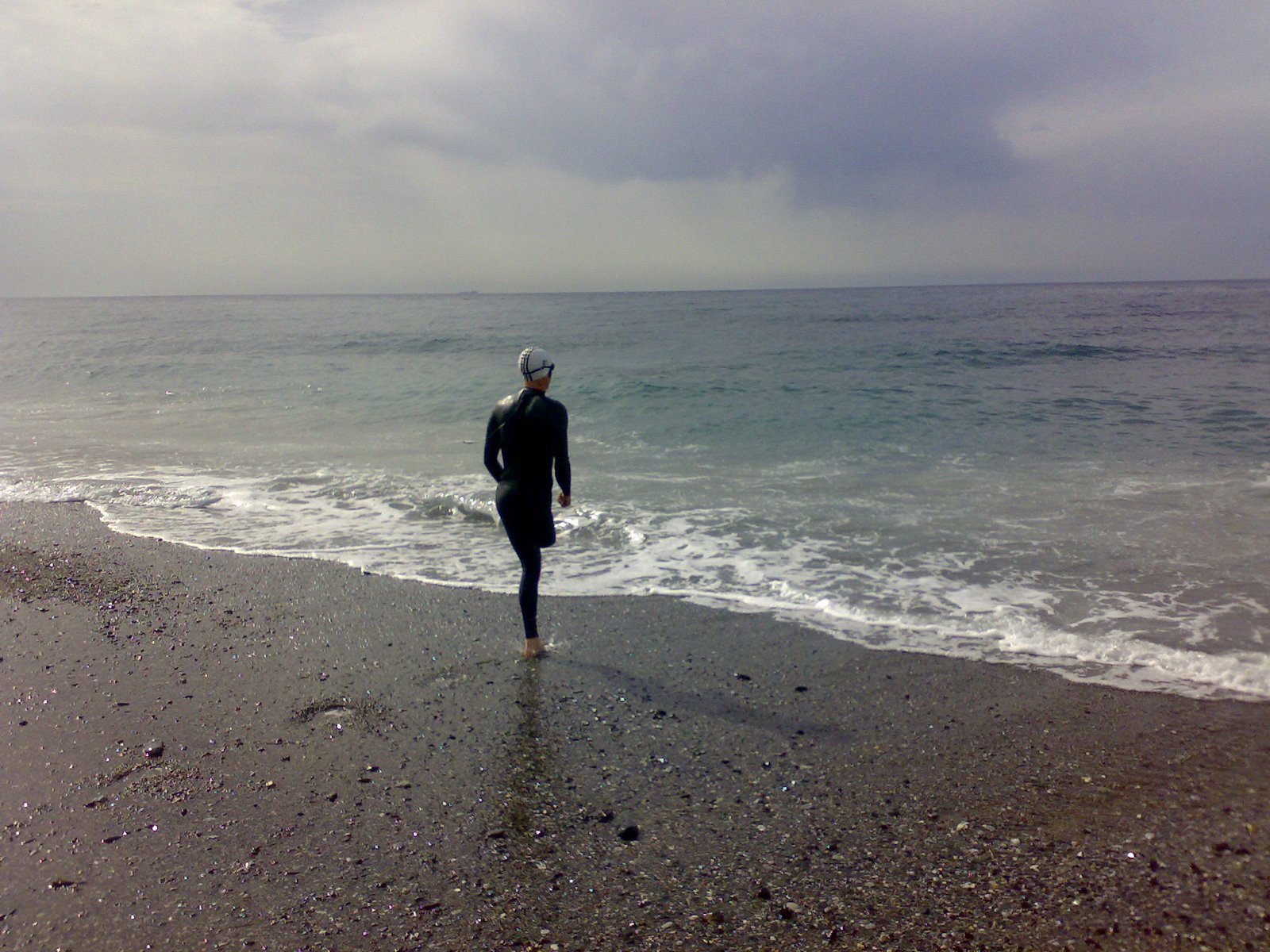
It was about 9:00 a.m. when I dived, the first impact was terrifying: I burned my face with the water for how it was freezing cold!
Just then, as if a flame had lit inside of me, that burning face almost made me vicious: instead of fear it gave me the strength and determination to vehemently pursue my goal: the success of this crossing would have made a decisive contribution to the realization of one of my dreams: a functional prosthesis center in the city of Goma, to meet the needs and especially the prayers of so many children, boys, men and women who are amputees: a life with less suffering, less tears, and more smiles and more flashes of joy.
The next stage will be in Africa, in the Democratic Republic of Congo, in the region of Lake Kivu at the border with Burundi and Rwanda, where I will try to unite the island of Idjwi and Goma City with a virtual bridge 40 kilometers long.
Many times the cold woke me up from my determination, with the freezing currents invading my body and lighting something in my brain, as if my heart had moved inside my head, making my skull tremble, and it would come and go.
Every twenty minutes I stopped to drink some supplements dissolved in hot water, it was a relief, and Miriam talked to me but I could not listen. Only once I heard her: do you feel cold? I told her almost with malice: don’t ask me again, it will bring more bad luck!
I did feel the cold, however, it was inside my whole body, but admitting it would have meant surrendering.
Every time I raised my head, the Southern Island was approaching, but it was still far away.
Then I tried to give myself new energy and more mental strength.
Suddenly before my eyes, like flashes, started to appear the faces of Antonio, Luisa, their children, Miriam, Vanessa, Roberto, Sharon, her husband, who I never met, John Kirwan, with their eyes that gave me confidence and courage. I thought I heard their voices, their prayers, that supported me. I could not disappoint them, I heard the voice of Alessandro, my son and of Stefania, my wife, who pushed me even further: the Southern Island began to appear in color.
I started to hear the people cheering me: was I dreaming? Was the cold taking over my senses? Instead I was really hearing them, with Philip who encouraged me for the goal was close, and Miriam who told me I was only five kilometers away from the arrival.
I felt like a lion, it seemed that I had entered the water only a few minutes earlier. I was flying! I really felt like I was flying!
The Southern Island was no longer an illusion: it was there!
It could have been two kilometers from land, It was my last stop, the twenty-fourth, I pushed forward with all my strength. I would tell myself: come on, you made it, when I suddenly felt the sea turning against me: shaking me, pushing me back, I suffered like never before until that moment. I couldn’t make it, yet land was at hand, I could see the waves crashing against it but couldn’t reach it, the sea would push me back. Then finally, after so much effort and so much pain, after 8 hours and 18 minutes, I touched the wall of Perano Head, near Tory Channel.
In an instant my dreams had materialized, I was happy, I cried with joy, God had listened to my prayers, I made it!
I feel that this miracle will help to give smiles, hope and confidence to so many children in Africa.
Thank you Miriam, thank you Antonio and your whole family, thanks to the entire Italian community in New Zealand, thanks to the Focolari Movement, thanks to the Italian Embassy, thanks to Donato Scioscioli, thanks to John Kirwan, Sharon, thanks to the media that have forwarded my message, thanks to Wellington and its Mayor, thank you New Zealand for welcoming me like a son.
Thanks to the Province of Rome, to Patrizia Prestipino, to Intermatica, to Claudio Castellani, to Simona, to Stefano Testini, to Filippo Tassara, to the family of Circolo Canottieri Aniene, to my family, to my wife and to my son, for supporting, for being so close, for listening to me. If one day all people with disabilities achieve an independent life, it will be for the contribution of you all.
Kia Ora
Salvatore Cimmino
0 commenti:
Posta un commento